
Dresden Planning Commission weighs in on data centers
By Catherine Carithers,
Weakley County Press
Communities everywhere are talking about data centers and the what ifs if a data center wants to move to town. The data center issue evokes strong opinions. Some are deeply opposed to data centers coming into their communities, some are ambivalent and even completely fine with the idea. Most of us rely on the internet. Data doesn’t go to a cloud, it is stored in a data center. Google’s AI defines a data center as “a physical room, building, or campus that houses computer systems, servers, data storage dives, and network equipment used to build, run, and deliver digital applications and services.” Companies have run data centers for decades to keep their business websites and email online and running, but suddenly, data centers are coming up everywhere. Why? To train and run AI data centers, more power and technology is required than operating an ordinary company website. The Dresden Municipal/Regional Planning Commission met Thursday, October 8 to continue discussion about data centers and the ordinances that regulate them. Commission member Paul Hutcherson asked for explanations concerning the environmental impacts, the operational demands of water and electricity and tax implications data centers bring.
Like any municipality, Dresden is zoned for specific development purposes, which dictates how each zone can be used. Dresden’s M-2 industrial complex zone is a potential data center site though has not yet received any applications for that purpose and Weakley County planners/developers do not seek these industries out. City officials are actively putting ordinances into place to safeguard the city in the event a data center wants to set down business. Members of the Planning Commission have been working in collaboration with community planners, Justin Crice and Donny Bunton, over a set of ordinances to recommend to the City Board. Bunton said that since data centers can not be outright banned in M-2 zones, ordinances dictate how the land a business occupies can/can not be used. Bunton suggested adding landscaping provisions to the following list of recommended data center ordinances:
• Be zoned in M-2 (Heavy Industry).
- Be located 500’ (data center) or 1,000’ (hyperscale data center) from nearest residential structure.
- Have minimum lot sizes of 5 acres (data center) and 20 acres (hyperscale data center)
- Be set back at least 100’ from all of their property lines.
- Provide a noise study and a utility impact analysis.
- Maintain a noise level beneath the maximum requirement.
- Provide adequate screening (as required by the Planning Commission).
Crice pitched an example of a $100 million industry occupying a space in the M-2 district that could bring in around $190,000 to the city and $230,000 in tax revenue to the county. For this reason and others, some TN cities are eager to bring in data centers, sell them electricity and take the tax revenue. Josh Lassiter, Director of Public Works said that Dresden has the capacity to supply 20,000 gallons/day of water and to collect the waste water. General Manager of Weakley County Municipal Electric System (WCMES) Andrea Herrington spoke to the Commission. TVA regulates WCMES and sets all stipulations. TVA passes the upfront cost to the developer for any system upgrades. TVA has done multiple capability studies and established rates for multiple categories including for data centers, which it has just released, October 1. A small data center using under 5 megawatts of electricity could easily be accommodated by WCMES in the M-2 area, said Herrington. Over 5mw, a data center would have to go directly through the TVA system, pay $1.5 million upfront for every mw above 5mw range of usage and pay for the feasibility study.
Several citizens addressed the Commission. Robert Gaylord from district 1 is opposed to data centers and worries about privacy because data centers “sell our private data” and about water and electricity use. Chase Gaylord worries about sound effects on wildlife because many people hunt birds and deer for food. David Chambliss lives in town and worries about toxic waste generated by data centers and about the city moving hastily enough to put into place ordinances to regulate data centers. Mayor Maddox suggested working with Donny Bunton to nail down ordinance revisions to recommend to the next City Mayor and Board of Alderman meeting scheduled for October 29.
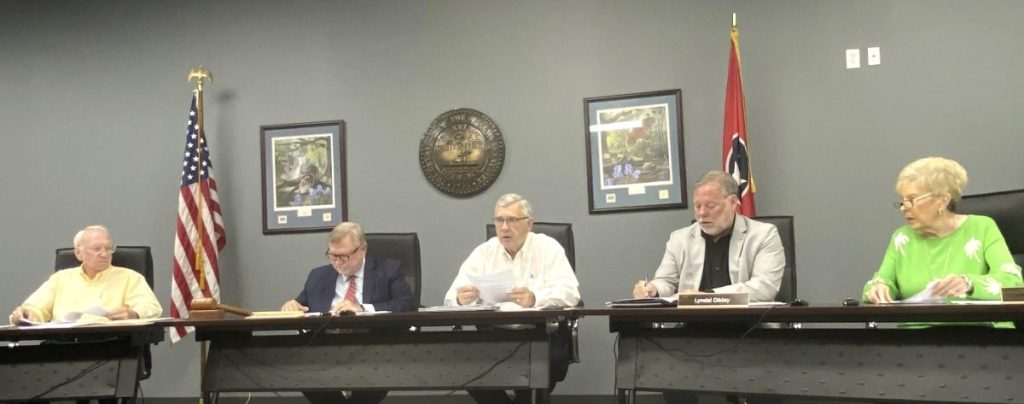
Planning Commission members Larry Jolly, Chairman Tommy Moore, Mayor Maddox, Paul Hutcherson and Joyce Hurt discuss data Center ordinances.
