
In memory of the Four Chaplains
By Clayburn Peeples, Special to The Press
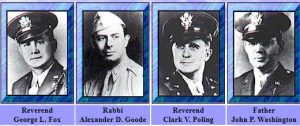 Today is Four Chaplains’ Day, a day once commemorated in nearly every house of faith in America in honor and remembrance of one of the most inspiring acts of sacrifice and valor during all of World War II, or, for that matter, any war ever.
When I was a boy, everybody knew their story, but as our “greatest generation” has faded away, so, regretfully, has our collective memory of the incredible sacrifices that generation made to help hold civilization together at a time when it was under assail by evil forces all around the world.
Sadly, many details of that generation’s sacrifice are pretty much forgotten today. Now there are other enemies to fight; people move on, they tend to forget, or are never even taught about our glorious past.
Or, in the increasingly narcissistic society we have allowed ourselves to become, they may just not care.
The Four Chaplains, in case you may not know their story, were on board an aging luxury liner, converted during World War II to a troop transport ship which was in the North Atlantic Ocean, carrying troops to Greenland, in early February 1943. Although originally designed for only about 500 passengers and crew, on this trip the SS Dorchester was loaded with 900 men, including four chaplains.
Their story sounds like a Hollywood movie script, but it was horrifyingly real. One of the chaplains, a Methodist minister named George Fox, had already fought one war. In 1917 he had quit school, lied about his age and joined the Army Medical Corps. Before he came home, he had won the purple heart, the silver star and the French Croix du Guerre.
But that wasn’t enough. Having been ordained a Methodist minister in 1934, he went back into the army, at age 42, as a chaplain, after Pearl Harbor.
The second chaplain, Alexander Goode, was a reform rabbi from Washington, D.C. with a PhD from Johns Hopkins. Fluent in Arabic, his dream was to work after the war to bring about peace between Arabs and Jews. He had tried to enlist in the Navy, before Pearl Harbor, but was turned down because of his poor eyesight. After Pearl Harbor, however, he tried again, with the Army. They said yes.
The third of the four chaplains, Father John Patrick Washington, was a priest. No kidding. Sounds like the beginning of one of those corny interfaith jokes people tell all the time, but this was no joke; it was real. Father Washington had also been turned down by the Navy because of poor eyesight, but like the first two, he joined the Army after Pearl Harbor.
The fourth chaplain, Clark Poling, a graduate of Yale Divinity School, was an ordained minister of the Reformed Church in America. He also volunteered after Pearl Harbor. In his final conversation with his father, also a minister, here’s what he said: “Pray for me. Not for my safe return, that wouldn’t be fair. Just pray that I shall do my duty . . . never be a coward . . . and have the strength, courage and understanding of a man. Just pray that I’ll be adequate.”
So there they were, four men of God, chaplains of different religions and creeds at a time when most of America felt strongly that such things mattered greatly. But the four had bonded together and become friends even before a German torpedo struck the Dorchester just after midnight on February 3, 1943.
When it did, pandemonium ensued, but the only thought in each chaplain’s mind was to provide aid and comfort to the 900 terrified men on board.
The torpedo having knocked out their electrical system, it was totally dark, but it was also obvious that the ship was sinking, and sinking fast. Almost at once, out of the black smoke the four chaplains emerged, spread out, praying for the dead and preaching courage to those still alive. One man attempted to run back to his quarters to retrieve his gloves but was stopped by Rabbi Goode. “Here,” the rabbi said, after removing his own gloves. “Take mine. I’ve got two pairs.”
He didn’t, of course, but he knew he wouldn’t be leaving the ship that night.
The final actions of the chaplains were to open a storage locker and begin to distribute life jackets. Very quickly, however, they ran out, with men still in line. “I can’t swim,” shrieked one of them, and one of the chaplains, it is lost to history which, took off his own life jacket and gave it to the terrified man. The other three chaplains immediately followed suit.
In less than a half hour it was over. The ship sank, and 675 men died either on board or in the frigid 34° waters that engulfed them. It was the worst single death toll for a US convoy during the entire war.
Among those who perished were all Four Chaplains, who, according to many of the 227 survivors, were last seen as the ship sank below the waves, their arms linked and backs braced against the slanting deck, still praying together for the dead and dying as they went down with the ship.
One survivor, who had witnessed the chaplains remove their own life jackets to give to other soldiers, said this: “It was the finest thing I have ever seen, or hope to see, this side of Heaven.”
It just might have been.
Remember all the men who perished that night in your prayers this Thursday, especially the heroic Four Chaplains. It’s the least we can do.
A nation that fails to honor its heroes is likely to have too few of them the next time they need them.
