
Prewitt – Advocating for communities
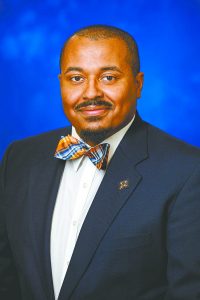
Anthony Prewitt
By Macenna True
Press Reporter
Black History Month began in 1915 when Carter G. Woodson traveled from Washington D. C. to Chicago, to participate in a celebration of the 50th anniversary of emancipation. Having been inspired by the turnout of thousands at the three-week event, Woodson- along with A.L Jackson and three others – formed the Association for the Study of Negro Life and History (ASNLH). Ten years later, he founded Black History Month. He chose February as the month to celebrate for two main reasons: tradition and reform. Former president, Abraham Lincoln, who signed the emancipation proclamation, was born Feb. 12. Frederick Douglass, who also played a prominent role in shaping black history, was born Feb. 14. Black Americans had since been celebrating their birthdays, and Woodson believed this would be a particularly good month to honor their own history. Ever since, it has been dedicated as the time to honor not only the triumphs, but also the struggles, of African Americans in U.S. history. Canada now also recognizes this month, as well as Ireland and the United Kingdom.
Anthony Prewitt is the interim director of student life and multicultural affairs at the University of Tennessee at Martin. A native of Memphis, he has worked at UTM for the last 16 years after completing his bachelor’s degree there and his master’s and pending doctoral degree at Murray State University. He is an advocate for community service, child abuse prevention and animal cruelty prevention. He enjoys working closely with students and assisting them to meet their goals while giving back to others. When asked what black history month meant to him, he stated, “To me, it is an opportunity to highlight an oftentimes overlooked and forgotten piece of American history. There are a lot of narratives and voices that have not always been amplified. It’s an opportunity to highlight, emphasize and connect with all of our history. It is an opportunity to celebrate not just the well-known heroes, but local giants – those who helped make strides within the community – who are often left out of the story and others’ narratives.”
Influenced by his adoptive mother Linda Street, Prewitt was inspired to serve others. Through her care and compassion, he says she “planted the seed and ensured the conditions were right for me to grow.” He also says his grandmother Flora Prewitt, held great influence in his life. He was also inspired by more well-known figureheads such as Martin Luther King, Jr., W.E.B Du Bois, and Thurgood Marshall. A music enthusiast and songwriter, even Tina Turner’s music and life story spoke to him. He continues to use their lessons to teach and inspire others.
He spoke of a time where his family would sit him down on the porch at their home in Grand Junction and tell him of the struggles they had overcome. This helped to instill in him an urgency to ensure he kept those familial stories alive but also a desire to create an awareness in others to keep their own ancestral roots intact by sharing their own narratives. He says, “It was so important for me in my own life and helped me choose the paths I have – both personally and professionally – to honor them by keeping that baton going for future generations. It was important to us to make sure we got it right and succeeded.” He muses that he would like to see this time be used for our community to learn and understand each others history as people. He states, “I think once we understand the fullness of who each other are as people, we are able to better live and coexist in society.” This is what this February is about – remembering not just the stories we all know, but those that have been told and passed down from generation to generation. It is a time to reconnect with the roots of an entire culture across the nation and to dig further into the truth.
Prewitt states, “I want to also highlight one of the biggest influences for me and many others here in our community. That is the historically African American fraternities and sororities who have been working really hard to lead movements to advocate for communities and serve as a voice for the voiceless. Also, they work to provide service for those communities which are often overlooked. Organizations such as the Urban League and the NAACP are great agencies as well.” If others want to know more, aside from the traditional Google search, there are many different ways to expand one’s knowledge. The Weakley County Reconciliation Project assists with this through an intent to uncover hidden history and has obtained very useful information through their work. He states, “We are losing so many of our elders whose stories have only been passed down through old traditions to their loved ones, and they are working hard to make sure these are recorded for others to have knowledge of in the future.” Libraries are another free resource with many interesting books filled with pages of history. He advises anyone that wants to learn more, to visit www.utm.edu/civilrights to see the host of events that the UTM Civil Rights Conference has coming up and to attend if they so desire. He encourages everyone to sit down with their families to reminisce and learn about the traditions and stories of their own family and keep that going in the future as well. History is not just what we learn in school. It is the lessons we learn by listening to those who have lived before us.
